Teaching GCSE Medicine Through Time for KS4 history

Discover lessons, activities, games and revision resources for teaching British history - Health and the people to KS4 history students

Tes Resources Team

Apothecary bottles for Medicine through time

Medicine Through Time is a popular GCSE history topic taught as the thematic unit of study for KS4 students. It explores the history of medicine in Britain and examines how and why medical knowledge, treatments and public health evolved from around c.1000 to the present day. The three major UK exam boards offering this unit as part of their specifications are:

  • AQA Paper 2: AA Britain: Health and the people: c1000 to the present day.
  • Cambridge OCR History B (Schools History Project) Component group 1: British History. This makes up the thematic study of this component which is The people's health, c1250 - present.
  • Pearson Edexcel Paper 1: Medicine in Britain, c1250 - present

The role of this unit on the curriculum is to help students understand continuity and change over time, explored through key themes such as power, religion, technology, war and the impact of significant individuals.

Through their study of Medicine Through Time, spanning approximately 1000 years, students develop skills of chronological understanding, recognising periods of progression and regression over time. They also analyse the causes and consequences of medical change, evaluate the significance of key milestones and discoveries, and identify agents of change. Students are encouraged to use primary and secondary historical source evidence to support their arguments, while critical thinking is fostered through balanced argument essays on themes such as change and continuity. These essays typically take the form of a 16-mark “balanced argument” question for AQA and Edexcel or an 18-mark, “How far do you agree?” question for OCR.

With such a rich and engaging topic, Medicine Through Time offers countless opportunities for teachers to get creative when producing lesson resources. Whether you’re planning lessons or supporting your students with GCSE revision, this guide will help you navigate the essential content and find the best resources for success.
Revision guides and workbooks

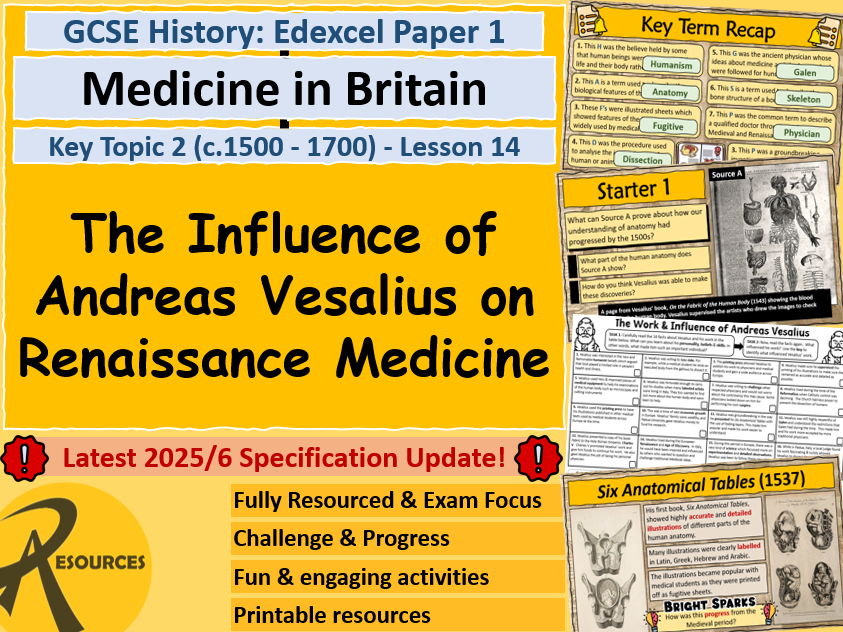
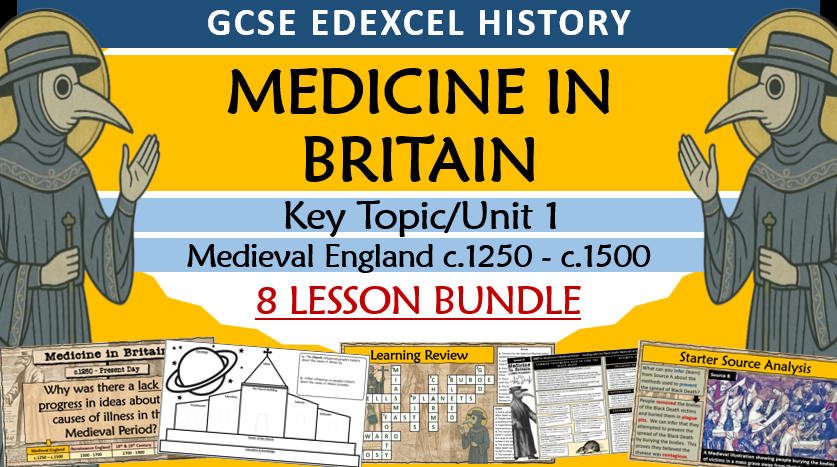
GCSE History Edexcel: Medicine in Britain UNIT 1 Bundle
RAResources

GCSE History Edexcel: Medicine in Britain UNIT 1 Bundle

8 Resources
This bundle contains 8 fully resourced lesson to guide you through teaching the Medicine in Britain, Unit 1 - Medicine in Medieval England (Edexcel). Every lesson contains starter activities, warm ups, recap tasks, printable worksheets, learning reviews and importantly printable fact sheets/knowled...
AQA GCSE History: Health and People Revision Workbook
PilgrimHistory

AQA GCSE History: Health and People Revision Workbook

(1)
**AQA GCSE Britain: Health and the People, C.1000AD to present** With revision constantly in full swing, I have started to make these revision workbooks which my Year 11 students love (as an alternative to death by PowerPoint). We pick certain sections (as part of a revision programme) to revise ...
MEDICINE / HEALTH AND THE PEOPLE REVISION / HOMEWORK BOOKLET
jamesmortimer55

MEDICINE / HEALTH AND THE PEOPLE REVISION / HOMEWORK BOOKLET

(1)
REVISION or HOMEWORK booklet for Medicine / Britain, Health and the People GCSE students. -Booklet covers entire course from medieval to present day. - Each part of the course has TWO pages: a section to READ the key information and a section to REVIEW the key knowledge. - Can be given to students...
Medicine through time: Revision Guide (Renaissance)
chennahlawrence

Medicine through time: Revision Guide (Renaissance)

(1)
This comprehensive revision guide (2/5) covers the Medicine Through Time topic, focusing on the Renaissance period for Edexcel GCSE History. It provides clear and concise explanations of key developments in medical knowledge, treatments, and public health during the Renaissance, with a focus on: Th...
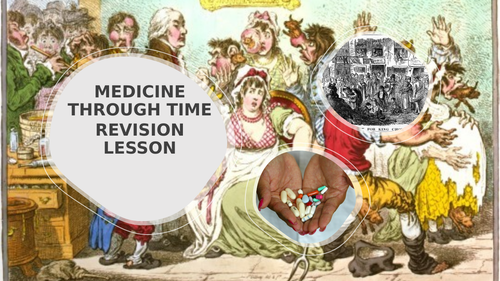
MEDICINE THROUGH TIME PRE-EXAMINATION REVISION LESSON
veronicajanewood

MEDICINE THROUGH TIME PRE-EXAMINATION REVISION LESSON

(1)
This lesson covers all of the questions for the GCSE EDEXCEL Medicine Through Time unit, and would be ideal to use for a last minute revision/intervention lesson with students. There are examples of each question-type with model paragraphs and opportunities for students to complete exam-style answe...
Health and the People: Parallel Timeline
j_leemosley

Health and the People: Parallel Timeline

(2)
This was created so that students have overview sheet to consolidate change and continuity for AQA Health and the People. I give it to students on their first lesson so they can continually add through the study of medicine. Its divided into surgery, public health, treatments and medical knowledge ...

Key periods to cover 

Delivering a topic that spans a vast period of time can feel overwhelming at first, but it’s an exciting opportunity to trace the evolution of health and medicine in Britain. This is especially true with such a fascinating theme. Many teachers take a chronological approach, drawing out key themes as they progress and encouraging students to compare and contrast developments over time.

If this is your preferred method of delivery, you might begin by outlining early societies’ supernatural explanations for illness and their use of charms and rituals to counteract disease. From there, introduce significant figures who began to challenge these ideas—such as Hippocrates, the “Father of Medicine”. His Four Humours theory and emphasis on observation established the belief that illness had natural causes, not supernatural ones, laying the foundations for rational medicine. Galen then expanded on Hippocrates’ ideas with the Theory of Opposites, aiming to restore humoral balance (for example, cooling treatments for fevers). He also advanced anatomical knowledge through animal dissection, developing a working understanding of how the body functions.

Moving into the Medieval era, medicine was heavily influenced by the Church, which promoted the idea that illness, plague and disease were punishments from God. Spiritual healing was prioritised; hospitals served largely as places to convalesce and pray under clerical supervision rather than treatment centres staffed by physicians. The Black Death (1347–1351) — which killed around one‑third of Europe’s population— appeared to reinforce these religious interpretations, but it also prompted early public‑health responses such as isolation and attempts at prevention.

In the Renaissance, the focus shifted towards observation and scientific inquiry. Key individuals such as Vesalius and Harvey challenged traditional ideas through anatomical studies and the discovery of the circulation of blood. The printing press accelerated the spread of new theories across Europe, reducing the Church’s dominance over medical knowledge and, for the first time, tipping the balance towards technology and scholarship as agents of medical change.

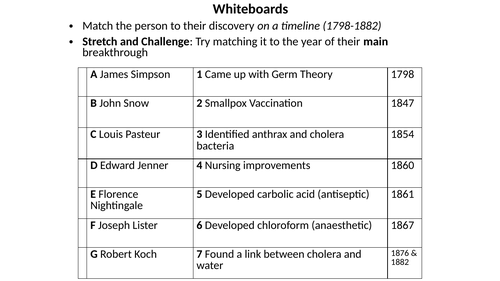
The Industrial era significantly transformed health in Britain, as rapid scientific progress revolutionised understanding of the causes and treatments of common diseases. Building on Edward Jenner’s pioneering smallpox vaccination in 1796, mid‑19th century breakthroughs accelerated change. John Snow demonstrated cholera’s waterborne transmission in 1854, and Louis Pasteur established germ theory in 1861. The introduction of anaesthetics in the mid‑19th century marked the beginning of the ‘surgical revolution’; agents such as ether and chloroform enabled pain‑free operations. Building on Pasteur’s findings, Joseph Lister introduced antiseptic surgery in 1865, dramatically reducing post‑operative infection rates.

The 20th century brought breakthroughs that define healthcare today. Further advancements in surgery and infection control were driven by the First World War, which accelerated techniques such as amputation, debridement and later plastic surgery to combat gangrene and infection. Alexander Fleming’s discovery of penicillin in 1928 revolutionised the treatment of infections, leading to the widespread use of antibiotics. The creation of the NHS in 1948 ensured free healthcare for all in the UK, transforming access to medical services. Later advances in DNA and genetics—including the discovery of DNA’s structure in 1953 and genome mapping completed in 2003—opened the door to diagnosing genetic disorders, developing new treatments and personalised medicine, shaping modern approaches to healthcare.

AQA Health and the People Significant Individuals Overview
Educ [AI]tor

AQA Health and the People Significant Individuals Overview

(1)
Explanation of the Resource: Significance of Individuals in Health and the People This resource is designed to support teachers in delivering engaging and evaluative lessons on the theme of significance within the context of the Health and the People study from c.1000 to the present day...
Medieval Medicine
EC_Resources_EXTRA

Medieval Medicine

(14)
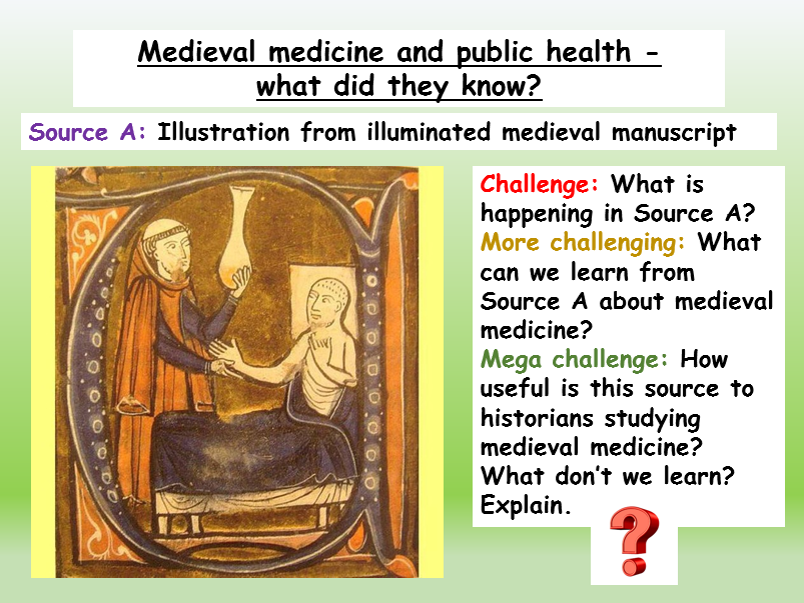
An hour long, fully resourced lesson with powerpoint, differentiated tasks throughout, worksheets, clip link and accompanying task focusing on an introduction to medieval medicine, causes, cures and sources with a focus on scientific stagnation, Galen and superstitious/religious beliefs. Designed to...
History of Medicine - Alexander Fleming
WolseyAcademy

History of Medicine - Alexander Fleming

(1)
Overview: Explore Alexander Fleming's discovery of penicillin and its monumental impact on the field of medicine. Activities: o Video Review: Watch educational videos to learn about the discovery of penicillin and its implications. o Timeline Sorting: Sequence key events in the development of a...

Teaching themes and engaging classroom ideas 

When planning lessons on Medicine Through Time, it is common to start by exploring the impact of major factors such as religion and belief, chance, war, power and government, science and technology and influential individuals. Many choose to build this foundation before moving on to analysing change and continuity over time as students’ contextual knowledge develops. Knowing and understanding major milestones, alongside agents of change, helps students appreciate how medical progress was shaped and continued to develop over time.

There’s plenty of scope to make this topic engaging: timeline activities are great for quick ‘place in time’ revision, while escape room challenges can reinforce understanding of key influential figures. Source analysis tasks such as cholera maps or WWI medical records help strengthen historical skills and debates on the ‘most important factor’, such as Germ Theory versus the Four Humours, encourage critical thinking and prepare students for attacking those all important 16-mark exam questions. For targeted revision, interactive quizzes, top trumps style cards, worksheets, workbooks and games are great timeless activities to consolidate learning. Pair these with assessment questions and model answers to boost exam confidence.

Medicine Through Time - GCSE History
Cre8tiveHumanities

Medicine Through Time - GCSE History

(1)
Medicine Through Time GCSE History Escape Room Engage your KS4 students with this fully interactive digital escape room, designed to explore the key content of the Medicine Through Time topic. Perfect as a revision activity, end-of-unit challenge, or start-of-term treat, this escape room offers...
Medicine through Time - Individuals flash cards
Polly James

Medicine through Time - Individuals flash cards

(3)
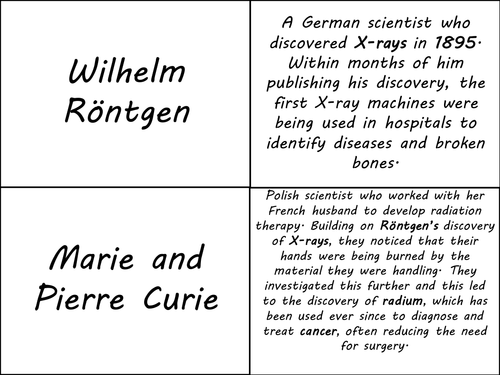
These cards include information about the (approx) 100 individuals (!) that students learn about during the 'old' Medicine through Time course. However, it can easily be adapted for the new Health and the People course by removing all of the Ancient World ones (apart from Hippocrates and Galen). ...
Modern Medicine Tetris Game- Interactive History Revision
jweston97

Modern Medicine Tetris Game- Interactive History Revision

(1)
Boost engagement with this printable, exam board-specific GCSE History revision game! Perfect for Medicine Through Time (Edexcel) and Health and the People (AQA), this low-prep classroom resource uses game-based learning and active recall to revise key knowledge from the Modern period. Students rol...
Medieval Medicine Knowledge Quiz - Questions and Answers
HerodotusTeacher

Medieval Medicine Knowledge Quiz - Questions and Answers

(1)
A quick knowledge quiz that can be used to double-check or test your student's knowledge of the first time period of the 'Medicine in Britain' module. Also could be used as revision, or even a homework task. What makes this resource so useful is that you have both the question sheet AND a PowerPoin...
History of Medicine Revision Game
DiscoveringHistory

History of Medicine Revision Game

(1)
This 'syringe & ladders' revision game is a perfect activity for GCSE students studying Medicine, Surgery & Public Health! Students can challenge each other and could either use their notes on the side to answer the questions or do it all from memory - writing down what questions they strug...